
Product photos
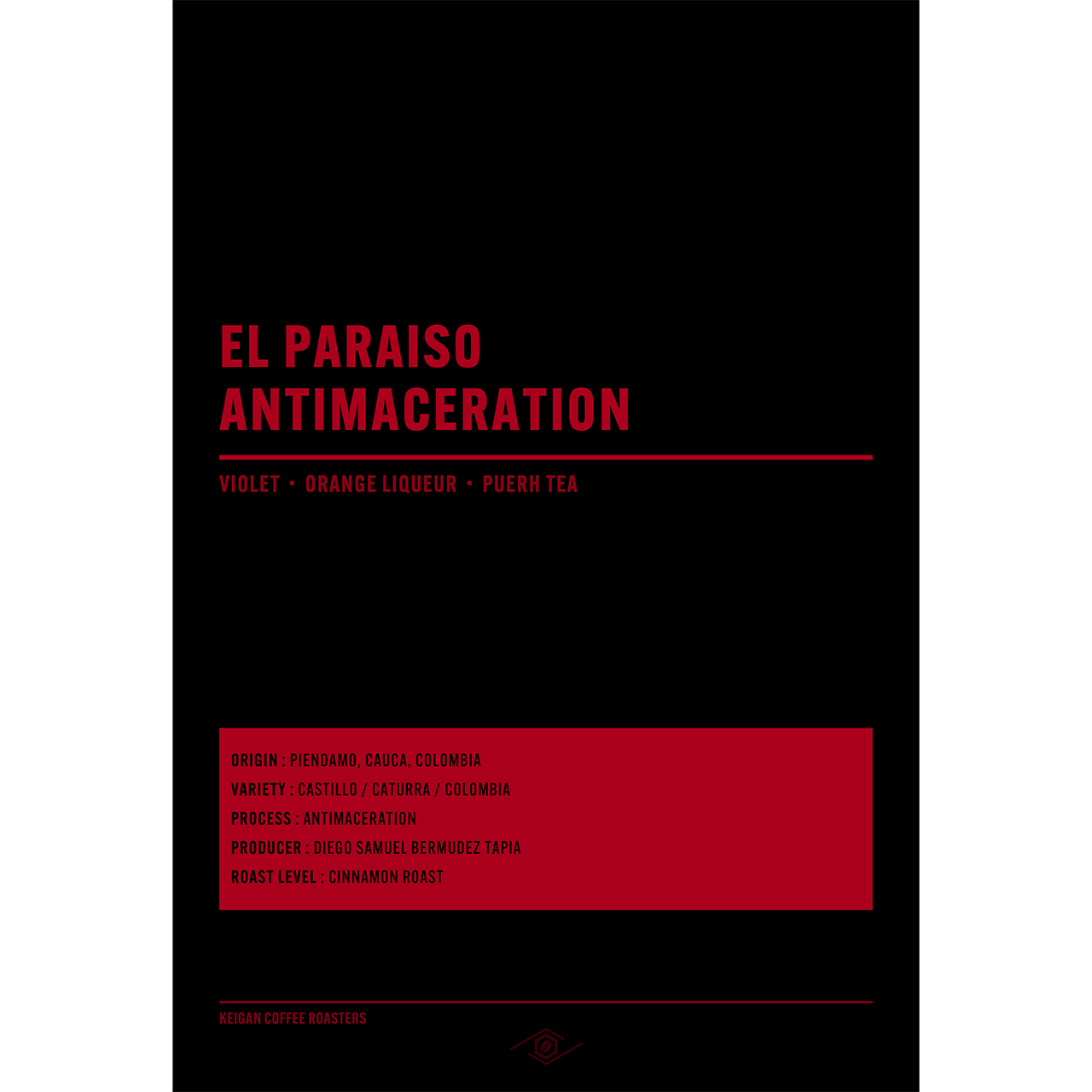
Colombia El Paraiso ANTIMACERATION
Regular price
¥4,400
Sale price
¥4,400
Regular price
Unit price
/
per
Sale
Sold Out
Tax included.
Shipping calculated at checkout.
Colombia El Paraiso Antimaceration
An elegant fragrance reminiscent of violet.
It has a lively acidity and sharp bitterness like orange liqueur.
ANTIMACERATION creates a multi-layered and complex flavor.
We will roast after receiving your order.
○ If you would like the beans ground, please enter this in the comments section of your cart. (Example: I would like them ground for my coffee maker / I would like them ground medium)
○ If you have selected "Store Pickup" and would like to specify a pickup date and time, please enter a date and time at least 72 hours in the future (during business hours) in the comments section of your cart. If you would like a date and time less than 72 hours in the future, please contact us via DM on Instagram.
○ The product will be delivered in a stand-up bag with a zipper and valve for easy storage. Please store it out of direct sunlight.
The expiration date is 90 days from the roasting date.
<How to brew>
These beans release water much faster than regular coffee beans, so please refer to the recipe below when brewing. We recommend aging them for one to two weeks after roasting.
《ANTIMACERATION exclusive recipe》
Dripper: Conical dripper Grind: Medium-fine (Miruko dial 3.5-4, finer than when making iced coffee)
Bean amount: 20g
Amount of water: 250g
Water temperature: 87℃
procedure:
① Rinse the paper.
②Pour 50g at a time, 5 times, for 30 seconds each.
③Once all the liquid has fallen, the extraction is complete.
< Bean details >
Farm: El Paraiso Farm Producer: Diego Samuel Bermúdez Tapia Country: Colombia Region: Cauca, Piendamo Variety: Castillo / Caturra / Colombia Processing: Antimaceration
Elevation: 1,960m
Roast level: Cinnamon roast (just before the first crack)
Contents: 100g
Bean number: 3017
Direct material cost rate: 47.5%
Flavor: Violet, orange liqueur, pu-erh tea
<Antimaceration>
This innovative process begins with the careful selection of perfectly ripe cherries, rich in sugars and aroma and flavor precursors. They are then first treated with ozone to eliminate unwanted microorganisms, and then transferred to sealed, vacuum-sealed tanks.
By removing the air from the tank and creating a negative pressure (vacuum), the cherries enter a spontaneous dehydration state, and the moisture and other components inside begin to move to the outside. This causes the fermented liquid to accumulate at the bottom of the tank, forming a two-layer structure.
The process that begins at this point is called the Antimaceration process:
The upper layer is less susceptible to oxidation, preserving the cherry's natural red color.
Meanwhile, the lower cherries are completely submerged in the fermentation liquid, allowing for deep infusion in the absence of oxygen.
This fermentation liquid fills the porous structure of the cherry, penetrating the flavor all the way down to the kernel, while simultaneously breaking down the polyphenols, turning the cherries a dark brown over time.
Once antimaceration is complete, the top and bottom layers are separated, revealing the bottom layer of cherries with a richer, more complex flavor.
Finally, the cherries are gently dried in dehumidified dryers using dry air, which prevents the loss of aroma and flavor due to high temperatures and produces a consistent aroma and clean finish without over-fermentation.
<Production cost (per 150g)>
① Direct material cost:
Material costs allow you to directly determine how much it costs to produce roasted beans.
(Example) Green beans, zipper bag with valve, front seal, back seal
The direct material cost rate for these beans (direct material cost ÷ list price × 100) is 47.5 % .
②Indirect material costs:
The cost of materials, which cannot be directly determined as the amount spent to produce roasted beans.
(Example) Teeth and rubber parts of a seal cutting machine ③ Direct labor costs:
Labor costs allow you to directly determine how much it costs to produce roasted beans.
(Example) Salaries paid to employees involved in manufacturing, such as roasting and putting roasted beans into bags. 4. Indirect labor costs:
Labor costs are costs that cannot be directly determined in order to produce roasted beans.
(Example) Salaries paid to employees not involved in manufacturing, such as clerical work ⑤ Direct expenses:
An expense that directly indicates how much it cost to produce roasted beans.
(Example) Costs incurred when outsourcing some of the manufacturing-related processing, such as putting roasted beans into bags, to an external company. 6. Indirect expenses:
Expenses that cannot be directly determined as to how much it cost to produce roasted beans.
(Example) Electricity/gas costs used for roasting, depreciation costs for the roaster, electricity costs for storing green beans at low temperatures
The total amount of items ① to ⑥ above is the manufacturing cost.
*Total cost is the cost when the manufacturing cost includes the selling expenses incurred for selling the product and the general administrative expenses incurred for the management activities of the entire store.
■ Domestic shipping (within Japan)
Once your order is placed, it will usually be shipped within 3-5 business days.
[Click Post (up to 400g of coffee beans)]
- If your order contains 400g or less of coffee beans , we will ship it via Click Post (Japan Post) .
- Nationwide shipping fee: 285 yen
- Delivery will be by post (tracking number available/date and time cannot be specified)
[Yu-Pack (401g or more or equipment)]
- Orders containing 401g or more of coffee beans or orders including coffee equipment will be shipped via Yu-Pack (Japan Post) .
- Shipping costs by region are as follows:
| region | postage |
|---|---|
| Shizuoka Prefecture | 644 yen |
| Kanto, Shinetsu, Hokuriku, Tokai, Kinki | 683 yen |
| Tohoku, Chugoku, and Shikoku | 757 yen |
| Kyushu | 863 yen |
| Okinawa | 1,061 yen |
| Hokkaido | 1,155 yen |
*Domestic shipping is free for orders over 5,400 yen (tax included).
■ International Shipping
- We also accept shipping outside of Japan. Currently, we can deliver to the following areas:
・Korea and Taiwan
・Hong Kong Special Administrative Region of the People's Republic of China ・Macau Special Administrative Region of the People's Republic of China ・Thailand ・Singapore ・Australia
- All deliveries are made using EMS (Japan Post) .
- Shipping costs are calculated automatically based on weight and delivery address.
- We aim to ship within 7 business days of your order.
- Delivery may take 5-21 business days (depending on region).
*Customs duties, import taxes and local fees are the responsibility of the customer.
*If the actual shipping cost differs significantly, we may contact you separately.
If you have any questions, please feel free to contact us on our official Instagram (@keigancoffee).
We will do our best to deliver your precious coffee as quickly and carefully as possible.
Q: Can you issue a receipt?
A: Receipts are issued to customers who request them. (Please note that receipts may not be issued depending on the payment method.) We will send it to you via email as soon as payment is confirmed.
[Credit Card / Apple Pay / Google Pay / Shop Pay / PayPal / PayPay / LINE Pay / au PAY]
Your direct contract for payment is with the credit company you use, and the "statement of use" issued by the credit company serves as your receipt.
If we issue a receipt, it will be a duplicate, so we will clearly state "Credit Card Payment / Apple Pay Payment / Google Pay Payment / Shop Pay Payment / PayPal Payment / PayPay Payment / LINE Pay Payment / au PAY Payment" on the receipt.
If you require a receipt, please enter "Receipt requested" in the remarks column of your cart when placing your order and specify the "Recipient name."
If no recipient is specified, the receipt will be addressed to the "Name" you entered when placing the order.
Also, please note that the address written on the receipt will be the "billing address" you entered at the time of payment. If you specify a different address from the shipping address, please be aware.
*The description cannot be specified.
[Bank Transfer]
The "transfer statement" or "withdrawal statement" issued by the bank (ATM) serves as the "receipt."
If we issue a receipt, it will be a duplicate, so we will clearly state "Bank Transfer" on the receipt.
If you require a receipt, please enter "Receipt requested" in the remarks column of your cart when placing your order and specify the "Recipient name."
If no recipient is specified, the receipt will be addressed to the "Name" you entered when placing the order.
Also, please note that the address written on the receipt will be the "billing address" you entered at the time of payment. If you specify a different address from the shipping address, please be aware.
*The description cannot be specified.
[Convenience Store Payment (KOMOJU)]
The receipt issued by the convenience store (customer copy) can be used as your receipt. We cannot send it from our store. Thank you for your understanding.
If you would like a specific recipient name, please enter it in the first and last name fields on the KOMOJU payment information entry screen, which you will be redirected to during the payment process.
If you need a receipt after receiving your product, please contact us via DM on our official Instagram (@keigancoffee).
Q: Do you issue receipts compatible with the invoice system?
A: We issue receipts compatible with the invoice system.
Please see below for registration numbers and other details.
Registration Number: T2810873406148
Name or Company Name: Takuya Ashikawa
Date of Registration: October 1, Reiwa 5 (2023)
Location of Principal Office: 834-16 Tadahara, Fuji City, Shizuoka Prefecture
Principal Trade Name: KEIGAN COFFEE ROASTERS
The above registration number can also be confirmed on the National Tax Agency's "Invoice System Qualified Invoice Issuer Disclosure Site."
Q: Is a statement (delivery note) included?
A: Our store is implementing paperless operations as part of our efforts to be environmentally friendly and protect customer personal information.
Please check your order details in the "Order Confirmation" email sent by our shop after your order.