
Product photos
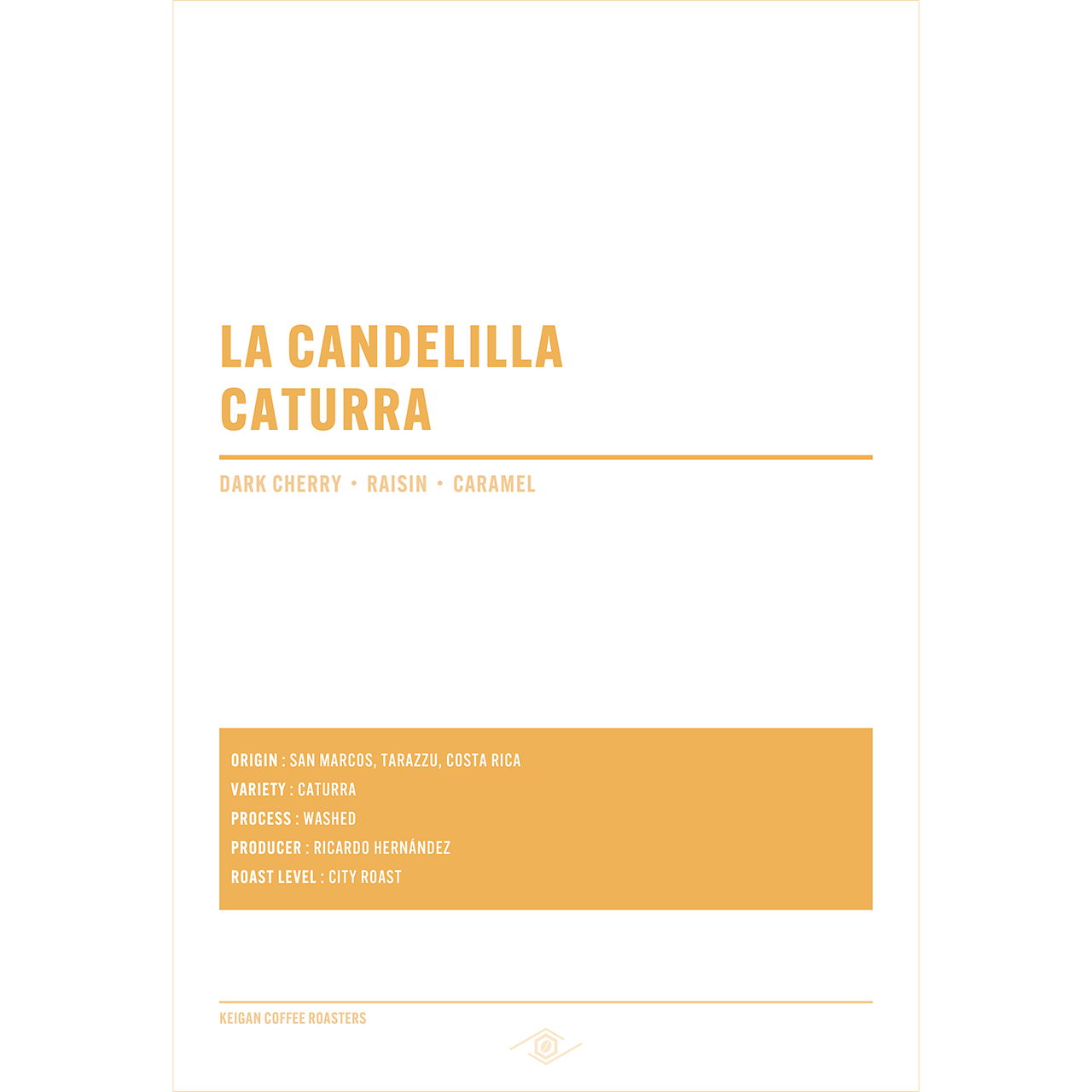
Costa Rica La Candelilla Caturra Washed
Regular price
¥1,440
Sale price
¥1,440
Regular price
Unit price
/
per
Sale
Sold Out
Tax included.
Shipping calculated at checkout.
Costa Rica La Candelilla Caturra Washed
Bright fruit flavours reminiscent of dark cherries.
Raisin-like depth and caramel sweetness.
The balance between thick texture and softness is pleasant.
We will roast after receiving your order.
○ If you would like the beans ground, please enter this in the comments section of your cart. (Example: I would like them ground for my coffee maker / I would like them ground medium)
○ If you have selected "Store Pickup" and would like to specify a pickup date and time, please enter a date and time at least 72 hours in the future (during business hours) in the comments section of your cart. If you would like a date and time less than 72 hours in the future, please contact us via DM on Instagram.
○ The product will be delivered in a stand-up bag with a zipper and valve for easy storage. Please store it out of direct sunlight.
The expiration date is 90 days from the roasting date.
<How to brew>
We recommend aging the coffee for 3 days to 1 week after roasting, and brewing it at around 87°C. (Click here for the brewing recipe we use.)
Hand drip (hot): Yes Hand drip (iced): Yes Immersion method (hot): Yes Immersion method (iced): Yes Cold brew coffee: Yes
<Bean details>
Farm: La Candelilla Producer: Ricardo Hernandez Country: Costa Rica Region: Tarrazu, San Marcos Variety: Caturra
Processing method : Washed Altitude: 1,400 - 1,600m
Roast level: City roast (just before the 2nd crack)
Contents: 150g/500g
Bean number: 1075
Direct material cost rate: 38.8%
Flavor: dark cherry, raisin, caramel
<Story>
LA CANDELILLA is a micromill located at an altitude of 1,500m in the Tarrazu region of Costa Rica.
Founded in 2000, the company is considered a pioneer in the country's specialty coffee industry. In 2015, it installed a state-of-the-art wet mill manufactured by Peñagos, achieving uniformity in the pulp removal process and highly precise quality control. It has also introduced a system that pays extra to pickers who harvest highly ripe cherries, leading to improved harvesting accuracy and working conditions for farmers.
<Purification method>
The harvested cherries are brought in in the afternoon, sorted in a siphon tank, and then pulped. They are then fermented for about half a day to remove the mucilage, and then dried 100% in the sun for about two days on African beds and about seven days on a concrete patio.
< Social Initiative "Casas de la Alegría"
Candelilla donates a portion of its profits to the "Casas de la Alegría Foundation" through Coffee Exparts, which exports green beans. This is a daycare project launched in 2014 by ICAFE and UNICEF that provides education, meals, medical care, and after-school care to the children of seasonal workers and pickers. Currently, 21 facilities have been established in the region, including Tarrazu, where children are supported to learn and grow in a safe environment.
<Production cost (per 150g)>
① Direct material cost:
Material costs allow you to directly determine how much it costs to produce roasted beans.
(Example) Green beans, zipper bag with valve, front seal, back seal
The direct material cost rate for these beans (direct material cost ÷ list price × 100) is 38.8 % .
②Indirect material costs:
The cost of materials, which cannot be directly determined as the amount spent to produce roasted beans.
(Example) Teeth and rubber parts of a seal cutting machine ③ Direct labor costs:
Labor costs allow you to directly determine how much it costs to produce roasted beans.
(Example) Salaries paid to employees involved in manufacturing, such as roasting and putting roasted beans into bags. 4. Indirect labor costs:
Labor costs are costs that cannot be directly determined in order to produce roasted beans.
(Example) Salaries paid to employees not involved in manufacturing, such as clerical work ⑤ Direct expenses:
An expense that directly indicates how much it cost to produce roasted beans.
(Example) Costs incurred when outsourcing some of the manufacturing-related processing, such as putting roasted beans into bags, to an external company. 6. Indirect expenses:
Expenses that cannot be directly determined as to how much it cost to produce roasted beans.
(Example) Electricity/gas costs used for roasting, depreciation costs for the roaster, electricity costs for storing green beans at low temperatures
The total amount of items ① to ⑥ above is the manufacturing cost.
*Total cost is the cost when the manufacturing cost includes the selling expenses incurred for selling the product and the general administrative expenses incurred for the management activities of the entire store.
■ Domestic shipping (within Japan)
Once your order is placed, it will usually be shipped within 3-5 business days.
[Click Post (up to 300g of coffee beans)]
- If your order contains 300g or less of coffee beans , we will ship it via Click Post (Japan Post) .
- Nationwide shipping fee: 285 yen
- Delivery will be by post (tracking number available/date and time cannot be specified)
[Yu-Pack (450g or more or equipment)]
- Orders of 450g or more of coffee beans or orders including coffee equipment will be shipped via Yu-Pack (Japan Post) .
- Shipping rates by region are as follows:
| region | postage |
|---|---|
| Shizuoka Prefecture | 644 yen |
| Kanto, Shinetsu, Hokuriku, Tokai, Kinki | 683 yen |
| Tohoku, Chugoku, Shikoku | 757 yen |
| Kyushu | 863 yen |
| Okinawa | 1,061 yen |
| Hokkaido | 1,155 yen |
*Domestic shipping is free for orders over 5,400 yen (tax included).
■ International Shipping
- We also accept shipping outside of Japan. Currently, we can ship to the following areas:
・Korea and Taiwan
・Hong Kong Special Administrative Region of the People's Republic of China ・Macau Special Administrative Region of the People's Republic of China ・Thailand ・Singapore ・Australia
- All deliveries are made using EMS (Japan Post) .
- Shipping costs are automatically calculated based on weight and delivery address.
- We aim to ship within 7 business days of your order.
- Delivery may take anywhere from 5 to 21 business days (depending on region).
*Customs duties, import taxes and local fees are the responsibility of the customer.
*If the actual shipping cost differs significantly, we may contact you separately.
If you have any questions, please feel free to contact us on our official Instagram (@keigancoffee).
We will do our best to deliver your precious coffee as quickly and carefully as possible.
Q Can I issue a receipt?
A : We issue receipts to customers who request them. (We may not be able to issue receipts depending on the payment method.) Once payment has been confirmed, we will send you a receipt by email.
[Credit card / Apple Pay / Google Pay / Shop Pay / PayPal / PayPay / LINE Pay / au PAY ]
Your direct contract for payment is with the credit company you use, and the "statement of charges" issued by the credit company will serve as your receipt.
If we issue it here, it will be a duplicate issue, so we will issue it clearly stating "Credit card payment / Apple Pay payment / Google Pay payment / Shop Pay payment / PayPal payment / PayPay payment / LINE Pay payment / au PAY payment."
If you require one, please enter "I would like a receipt" in the comments section of your shopping cart when placing your order and specify the name to which you would like the receipt.
If no designation is given, the name will be used as entered when placing the order.
Also, the address that will be printed on the receipt will be the "billing address" that you entered when making payment, so please be careful if you specify an address that is different from the shipping address.
[Bank Deposit]
The "transfer details" or "withdrawal details" issued by the bank counter (ATM) will serve as your "receipt."
If we were to issue it here, it would be a duplicate issue, so we will issue it with "Bank transfer" clearly stated.
If you require one, please enter "I would like a receipt" in the comments section of your shopping cart when placing your order and specify the name to which you would like the receipt.
If no designation is given, the name will be used as entered when placing the order.
In addition, the address that will be printed on the receipt will be the "billing address" that you entered at the time of payment, so please be careful if you specify an address that is different from the shipping address.
[Convenience store payment (KOMOJU)]
The receipt issued by the convenience store (customer copy) can be used as a receipt. We are unable to send you a receipt. Thank you for your understanding.
If you have a preferred name, please enter it in the name field on the KOMOJU payment information input screen to which you will be redirected during the payment process.
If you need a receipt after receiving your product, please contact us via DM on our official Instagram (@keigancoffee).
Q: Do you issue receipts that comply with the invoice system?
A We issue receipts that comply with the invoice system.
Please see below for registration numbers etc.
Registration number: T2810873406148
Name: Takuya Ashikawa
Date of registration: October 1, 2023
Head office address: 834-16 Tadehara, Fuji City, Shizuoka Prefecture
Main store name: KEIGAN COFFEE ROASTERS
The above registration number can be found on the National Tax Agency's "Invoice System Eligible Invoice Issuer Public Information Site"
You can also check it out here.
Q: Will an itemized statement (delivery note) be enclosed?
A: Our store is implementing paperless operations to protect the environment and to protect our customers' personal information.
Please check the details of your order in the "Order Confirmation" email that we will send you after you place your order.