
Product photos
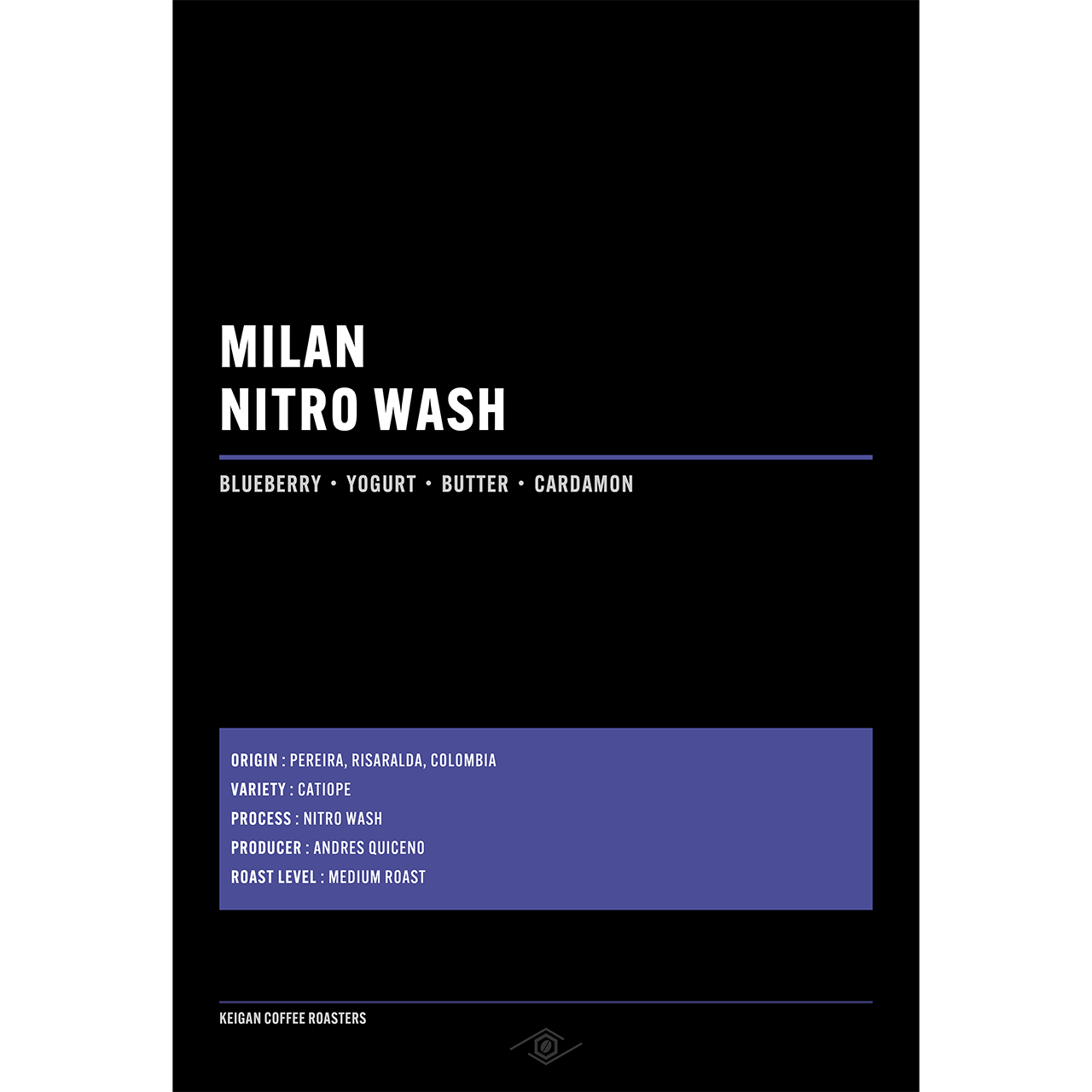
Colombia Milan Catihope Nitro Washed
Regular price
¥2,700
Sale price
¥2,700
Regular price
¥2,700
Unit price
/
per
Sale
Sold Out
Tax included.
Shipping calculated at checkout.
A rich blueberry-like flavor with a smooth mouthfeel.
Several spices can be tasted in the aftertaste.
○ Roasted after order is placed.
○ If you wish to have your beans ground, please enter your preference in the notes section of your cart. (e.g., "Please grind for a coffee maker" / "Please grind to a medium consistency")
○ If you select "Store Pickup" and have a preferred pickup date and time, please enter a date and time that is at least 72 hours in advance (within business hours) in the notes section of your cart. If you wish to pick up in less than 72 hours, please contact us via Instagram DM.
○ We will deliver the beans in a stand-up pouch with a zipper and valve, suitable for storage. Please store in a place out of direct sunlight.
○ Best before 90 days from the roasting date.
We recommend aging the beans for 1-2 weeks after roasting and extracting at around 92°C. (Our brewing recipe can be found here)
Hand Drip (Hot): 〇
Hand Drip (Iced): 〇
Immersion (Hot): 〇
Immersion (Iced): 〇
Cold Brew Coffee: 〇
Bean Details>
Farm: Milan Farm
Producer: Andres Quiceno
Country: Colombia
Region: Risaralda
Variety: Catiop
Processing Method: Nitro Washed
Altitude: 1,400m
Roast Level: Medium Roast (End of 1st crack)
Contents: 150g / 500g
Bean Number: 2015
Flavor Notes: Blueberry, Yogurt, Butter, Chinese Tea, Cardamom, Nutmeg
Milan Farm focuses solely on varieties that are gaining global attention and continuously develops new processing methods. They are particularly active in the "Culturing Process." Through this processing method, they enhance the flavors of varieties that are not as overtly flamboyant as "Geisha" or "Bourbon," as well as "Castillo," a disease-resistant and easy-to-grow variety, thereby expanding the possibilities of coffee.
Concurrently, in collaboration with universities and research institutions, they are analyzing data by comparing and investigating the changes and ratios of bacterial species brought about by the "Culturing Process" with those of regular "Castillo."
Milan Farm is located in the Andes Mountains of Risaralda Department, spanning 1400-1800m with hot springs and volcanic soil. They produce diverse micro-lots alongside crops such as plantains (green bananas), corn, and beans. Everyone working on the farm is treated like family, and it is evident that the entire team aims to improve farm production and processes.
① Cherries are harvested, sorted, and then pulped.
② The parchment coffee is then transferred to tanks for fermentation. Nitrogen, yeast, and enough water to cover the coffee are added, and it ferments for 3-4 days in this state.
③ After washing with clean water, it proceeds to the drying stage. Natural drying takes approximately 20-30 days.
Yeast samples from Milan Farm are sent to a laboratory in Bogotá for analysis.
The analysis revealed that the yeasts used this time (two types) are most active and promote fermentation activities specifically in a nitrogen-only environment.
They introduced machinery to generate nitrogen from oxygen and repeated trials and errors.
Starting with small quantities and adjusting towards the desired flavor through cupping, this process was perfected.
① Direct Material Costs:
Material costs that can be directly identified as incurred to produce roasted beans.
(e.g., green beans, valved zipper bags, front label, back label)
The direct material cost ratio for these beans (Direct Material Costs ÷ List Price × 100) is 39.0%.
② Indirect Material Costs:
Material costs that cannot be directly identified as incurred to produce roasted beans.
(e.g., blades and rubber parts for label cutting machines)
③ Direct Labor Costs:
Labor costs that can be directly identified as incurred to produce roasted beans.
(e.g., wages paid to employees involved in manufacturing, such as roasting and bagging roasted beans)
④ Indirect Labor Costs:
Labor costs that cannot be directly identified as incurred to produce roasted beans.
(e.g., wages paid to employees not involved in manufacturing, such as administrative staff)
⑤ Direct Expenses:
Expenses that can be directly identified as incurred to produce roasted beans.
(e.g., costs incurred when outsourcing a part of the manufacturing process, such as bagging roasted beans, to an external vendor)
⑥ Indirect Expenses:
Expenses that cannot be directly identified as incurred to produce roasted beans.
(e.g., electricity/gas costs used for roasting, depreciation of the roasting machine, electricity costs for storing green beans at low temperatures)
The total of ① to ⑥ above constitutes the manufacturing cost.
* The total cost is the manufacturing cost plus selling expenses incurred for product sales and general administrative expenses for the overall management activities of the store.
■ Domestic shipping (within Japan)
Once your order is placed, it will usually be shipped within 3-5 business days.
[Click Post (up to 400g of coffee beans)]
- If your order contains 400g or less of coffee beans , we will ship it via Click Post (Japan Post) .
- Nationwide shipping fee: 285 yen
- Delivery will be by post (tracking number available/date and time cannot be specified)
[Yu-Pack (401g or more or equipment)]
- Orders containing 401g or more of coffee beans or orders including coffee equipment will be shipped via Yu-Pack (Japan Post) .
- Shipping costs by region are as follows:
| region | postage |
|---|---|
| Shizuoka Prefecture | 644 yen |
| Kanto, Shinetsu, Hokuriku, Tokai, Kinki | 683 yen |
| Tohoku, Chugoku, and Shikoku | 757 yen |
| Kyushu | 863 yen |
| Okinawa | 1,061 yen |
| Hokkaido | 1,155 yen |
*Domestic shipping is free for orders over 5,400 yen (tax included).
■ International Shipping
- We also accept shipping outside of Japan. Currently, we can deliver to the following areas:
・Korea and Taiwan
・Hong Kong Special Administrative Region of the People's Republic of China ・Macau Special Administrative Region of the People's Republic of China ・Thailand ・Singapore ・Australia
- All deliveries are made using EMS (Japan Post) .
- Shipping costs are calculated automatically based on weight and delivery address.
- We aim to ship within 7 business days of your order.
- Delivery may take 5-21 business days (depending on region).
*Customs duties, import taxes and local fees are the responsibility of the customer.
*If the actual shipping cost differs significantly, we may contact you separately.
If you have any questions, please feel free to contact us on our official Instagram (@keigancoffee).
We will do our best to deliver your precious coffee as quickly and carefully as possible.
Q: Can you issue a receipt?
A: Receipts are issued to customers who request them. (Please note that receipts may not be issued depending on the payment method.) We will send it to you via email as soon as payment is confirmed.
[Credit Card / Apple Pay / Google Pay / Shop Pay / PayPal / PayPay / LINE Pay / au PAY]
Your direct contract for payment is with the credit company you use, and the "statement of use" issued by the credit company serves as your receipt.
If we issue a receipt, it will be a duplicate, so we will clearly state "Credit Card Payment / Apple Pay Payment / Google Pay Payment / Shop Pay Payment / PayPal Payment / PayPay Payment / LINE Pay Payment / au PAY Payment" on the receipt.
If you require a receipt, please enter "Receipt requested" in the remarks column of your cart when placing your order and specify the "Recipient name."
If no recipient is specified, the receipt will be addressed to the "Name" you entered when placing the order.
Also, please note that the address written on the receipt will be the "billing address" you entered at the time of payment. If you specify a different address from the shipping address, please be aware.
*The description cannot be specified.
[Bank Transfer]
The "transfer statement" or "withdrawal statement" issued by the bank (ATM) serves as the "receipt."
If we issue a receipt, it will be a duplicate, so we will clearly state "Bank Transfer" on the receipt.
If you require a receipt, please enter "Receipt requested" in the remarks column of your cart when placing your order and specify the "Recipient name."
If no recipient is specified, the receipt will be addressed to the "Name" you entered when placing the order.
Also, please note that the address written on the receipt will be the "billing address" you entered at the time of payment. If you specify a different address from the shipping address, please be aware.
*The description cannot be specified.
[Convenience Store Payment (KOMOJU)]
The receipt issued by the convenience store (customer copy) can be used as your receipt. We cannot send it from our store. Thank you for your understanding.
If you would like a specific recipient name, please enter it in the first and last name fields on the KOMOJU payment information entry screen, which you will be redirected to during the payment process.
If you need a receipt after receiving your product, please contact us via DM on our official Instagram (@keigancoffee).
Q: Do you issue receipts compatible with the invoice system?
A: We issue receipts compatible with the invoice system.
Please see below for registration numbers and other details.
Registration Number: T2810873406148
Name or Company Name: Takuya Ashikawa
Date of Registration: October 1, Reiwa 5 (2023)
Location of Principal Office: 834-16 Tadahara, Fuji City, Shizuoka Prefecture
Principal Trade Name: KEIGAN COFFEE ROASTERS
The above registration number can also be confirmed on the National Tax Agency's "Invoice System Qualified Invoice Issuer Disclosure Site."
Q: Is a statement (delivery note) included?
A: Our store is implementing paperless operations as part of our efforts to be environmentally friendly and protect customer personal information.
Please check your order details in the "Order Confirmation" email sent by our shop after your order.